Numerical weather prediction
Early in the twentieth century, the British mathematician, physicist, and meteorologist Lewis Fry Richardson dreamed of the possibility of predicting the future of the atmosphere by applying physical theories and advancing ‘computations faster than the weather advances’ (Richardson, 1922: 1).
Richardson’s methodology was to render the physical principles underlying the behaviour of the atmosphere as a system of mathematical equations and apply finite difference methods to produce quantitative approximations of atmospheric states on which predictions could be based.
This approach, he hoped, would make intuitive weather forecasting more accurate by rendering relevant meteorological dynamics subject to iterative mathematical modelling.
Richardson’s initial attempt to apply numerical weather prediction methods to actual atmospheric events in Europe, however, was disastrous: the ‘phenomenal volume of numerical computation’ required exceeded existing human and machinic capacities (Lynch, 2008: 3433). It was not until the advent of digital computing in the late 1940s that numerical weather prediction would be realised.
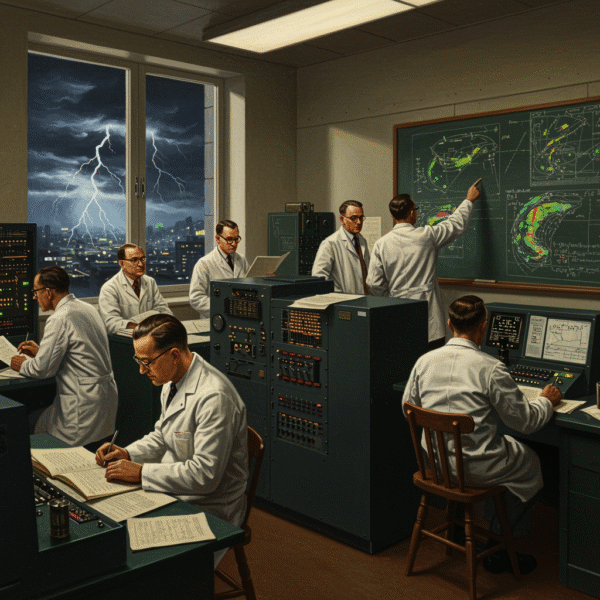
Sponsored by the U.S. Office of Naval Research, the Institute for Advanced Study (IAS) Meteorology Project ran from 1948 to 1956 under the direction of the mathematician John von Neumann and the meteorologist Jule Charney, with a focus on ‘preparing mathematical models of atmospheric systems so that rapid forecasts could be made’ (Wing, 1979).
After a violent storm hit Princeton in November of 1950, Charney’s team developed a three-level model of that particlar weather system (Wing, 1979). The results of four 24-hour forecasts, run on the ENIAC computer in Aberdeen, Maryland, confirmed that ‘the large-scale features of mid-tropospheric flow could be forecast barotropically with a reasonable resemblance to reality’ (Lynch, 2008: 3456).
As each 24-hour weather forecast required about 24 hours of computation, the team was ‘just able to keep pace with the weather’ (Lynch, 2008: 3456). By 1953, the IAS computer could produce 24-hour forecasts in six minutes (Wing, 1979). Richardson’s vision of numerical weather prediction had finally materialised.
The post-war relationships among mathematics, digital computing, and atmospheric prediction, however, were not straightforward or uncomplicated. Although the advent of numerical weather prediction is often narrated as transforming forecasting from ‘an intuitive art into a computational science’ (Edwards, 2010), hunches, heuristics, and guesswork continued to play a significant role in computational meteorology through the twentieth century.
Today, a particular kind of intuition informs weather and climate modelling via the use of proxies, which ‘stand-in for something that cannot be modeled directly but can still be estimated, or at least guessed’ (Edwards, 2010: 338). This allows atmospheric forecasting to expand ‘the estimable beyond the calculable’ (Hoyng, 2025: 9).