Neural network
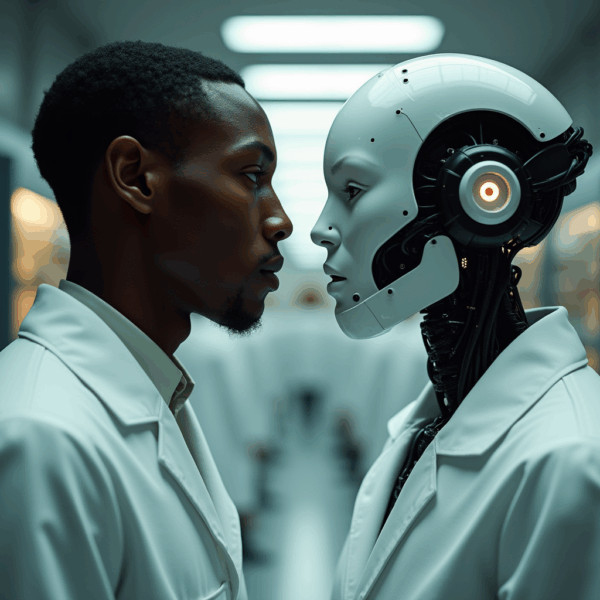
Neural networks, inspired by biological neurons, mimic cognition through interconnected nodes, learning patterns via algorithms.
The cyberneticists were the first to bring computational and neurophysiological processes formally together – most influentially in Warren McCulloch and Walter Pitts’ (1943) early work on neural networks. Their research not only introduced the computer as a generative (if partial and problematic) model for the brain but also ‘consolidated the notion that computers ought to be built as digital machines’ (Wilson, 2010: 11, 13).
In 1958, the psychologist and engineer Frank Rosenblatt’s perceptron, an algorithm for supervised learning of binary classifiers, pioneered the idea of using neuroscience to guide learning machines.
Amid influential critiques of perceptron models (Minsky and Papert, 1969) and Rosenblatt’s untimely death 1971, however, work on artificial neural networks stalled until the 1980s when it was revived by “connectionist” researchers to explore how these models could learn and handle information in a more flexible and intuitive way than symbolic processing AI.
In 1986, the psychologist David Rumelhart, with computer scientists Geoffrey Hinton and Ronald Williams, advanced a method for training neural networks called ‘backpropagation’ that works by attributing reduced significance to an event as it moves further back in the chain of events. This enabled the development of machine learning algorithms for natural language processing, visual image classification and analysis, and machine translation.
The post-millennial rise of “artificial intuition” is linked primarily to the capacity of advanced neural networks to learn, experiment, classify, and predict by continually ‘extracting features from [their] data environments’ (Amoore, 2020: 65). It entails the ability of machine learning algorithms to form complex correlations across large sets of data in real-time, enabling anticipation of associated behaviours to be tracked, amplified, and/or optimised.