The Imitation Game
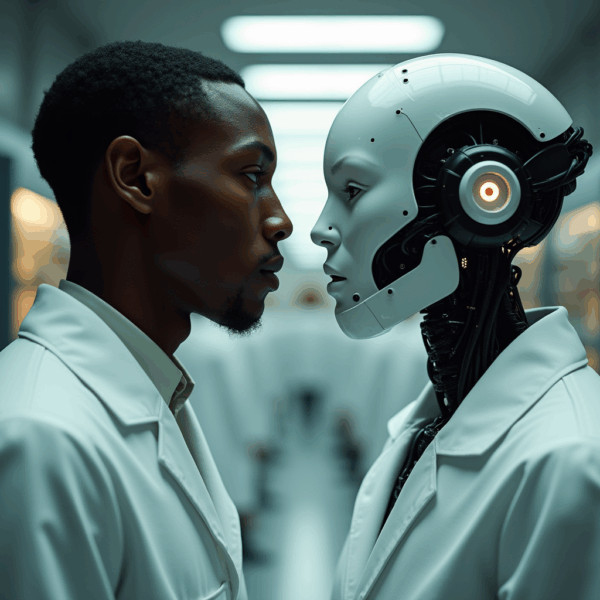
The Imitation Game is a thought experiment conceptualised by the mathematician Alan Turing to imagine the possibility of machine intelligence.
Opening with the provocative question ‘Can machines think?’, Turing’s most famous paper, ‘Computing Machinery and Intelligence’, was published in 1950 in the philosophy journal Mind.
Quickly deeming this original question too imprecise to operationalise, Turing suggests an imaginative thought experiment instead: The Imitation Game would ‘be played by three people, a man (A), a woman (B), and an interrogator (C)’, who would ‘stay in a room apart from the other two’ and whose objective would be, through strategic questioning, to determine which ‘is the man and which is the woman’ (Turing, 1950: 433).
Having outlined the ground rules, Turing then asks, ‘What will happen when a machine takes the part of A in this game?’ (1950: 434). When a digital computer can fool an interrogator into believing it is a human subject seven times out of ten, he suggests that we will have to accept the existence of machine intelligence.
Turing’s longstanding interest in “thinking machines” was linked to the emergence of the first general purpose digital computers at the end of the Second World War – including the Small-Scale Experimental Machine at the University of Manchester, to which he contributed directly (Hodges, 1983).
Although these early computers lacked the memory capacity, electronic speed, and programming sophistication to be serious contenders in the Imitation Game, Turing’s interest in 1950 is primarily speculative rather than empirical: ‘we are not asking whether all digital computers would do well in the game nor whether the computers at present available would do well, but whether there are imaginable computers which would do well’ (Turing, 1950: 436).
Turing’s imperative is not to operationalise the imitation game – later known as the “Turing Test” – to prove the existence of machine intelligence, or to provide criteria by which we might definitively either equate or distinguish “human” from “machine” (Pedwell, 2022).
Rather, as the cultural theorist Elizabeth A. Wilson (2010) argues, Turing voices a plea for imaginative expansiveness concerning the possible futures of machine intelligence – futures in which the boundaries between organic and inorganic, biology and technology, and human and machine are complex, emergent, and undetermined.