Affective computing
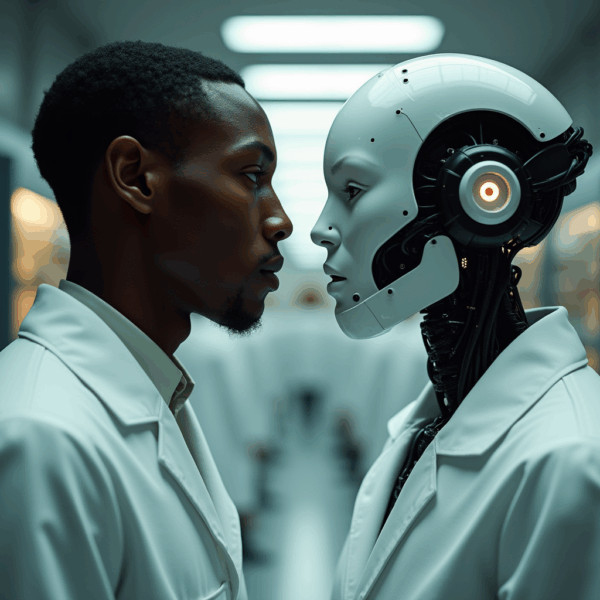
Affective computing enables computational systems and devices to recognise, process, and simulate human emotions. Pioneered by the computer scientist Rosalind Picard in the 1990s, it is an interdisciplinary field which brings together cognitive science, psychology, and computer science.
As Picard wrote in 1997, ‘the essential role of emotion in both human cognition and perception, as demonstrated by recent neurological studies, indicates that affective computers should not only provide better performance in assisting humans, but also might enhance computers’ abilities to make decisions’ (Picard, 1997: 1).
Questions of affect, feeling, and the sensory, however, were more pertinent to digital computing in the 1940s and 1950s than is commonly recognised, amid the interactions among neurophysiology, mathematics, computer science, information theory, and psychology that cybernetics entailed.
As the cultural theorist Elizabeth A. Wilson notes, ‘the relationship between artificiality and affectivity’ permeated ‘the early, heady years of computation – when the first calculating machines were imagined and built and when the conceptual parameters of electronic calculation were first being fashioned’ (Wilson, 2010: xviii).
The role of affect in human cognition took centre stage, for instance, in a 1952 BBC broadcast entitled ‘Can Automated Calculating Machines Be Said To Think’, featuring the mathematicians Alan Turing and Max Newman, the philosopher R.B. Brathwaite, and the neurologist Geoffrey Jefferson.
For Jefferson, any meaningful account of ‘thinking’ must address the significance of ‘external stimuli’; extraneous socio-affective factors ‘like worries of having to make a living, or paying ones taxes, or get the food one likes’. A machine, he emphasises, ‘has not an environment’, and yet ‘man is in constant relation to his environment, which, as it were, punches him while he punches back’ (BBC, 1952).
This affective emphasis in debates about machine intelligence shifts, however, from the mid-1960s as cybernetics and early neural network research stalls following trenchant critiques. With the consolidation of logic-based AI, visceral sensory-affective and neuro-physiological relations are reformulated as cognitive “emotional” processes understood to be discrete, categorizable, and amenable to logical algorithmic modelling.
Different strands of AI research have since explored how affect might better figure in synthetic learning and sense-making. At MIT Media Lab from the mid-1990s, for instance, the roboticist Rodney Brooks’ ‘novelle AI’ sought to build artificial agents which demonstrated a responsive distributed intelligence with ‘the capacity for growth’ (Wilson, 2010: 4).
This new AI animated an intuitive intelligence cultivated directly via ongoing environmental interactions populated by sensory, perceptual, and behavioural data.
Today, proliferating sensor technologies underpinned by machine learning algorithms are transforming sensing practices through ‘ensembles of multiple humans and more-than-humans, environments and technologies, politics and practices’ (Gabrys, 2019: 273).
When it comes to how sensory, affective, and physiological data is measured, interpreted, and mobilised, however, much mainstream AI research remains bound to the cognitivist paradigm that took shape in the second half of the twentieth century.
Common computational techniques such as sentiment analysis, for instance, involve ‘the tabulation and classification of common words for emotional expression based on their frequency’ (Stark, 2018: 214). In providing statistical proxies for affective intensities’ (Andrejevic, 2013: 54), such approaches lack robust means of addressing affective experience that exceeds language.
As Geoffrey Jefferson underscored in 1949, ‘of the vast stream of sense data that enters into our nervous systems we are aware of few and we name still fewer … Only by necessity do we put a vocabulary to what we touch, see, taste and smell, and to such sounds as we hear that are not themselves words’ (Jefferson, 1949: 1109).