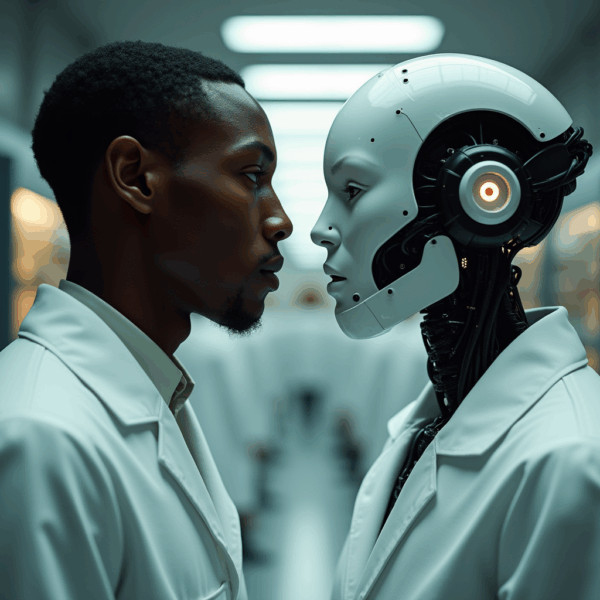
Algorithmic thought
What has been diagnosed as ‘the algorithmic condition’ (Coleman et al, 2018) addresses not only how people think, talk, or become aware of algorithms in daily life, but also how the growing ubiquity of machine learning technologies may be transforming the nature of thought itself.
The philosopher Michel Serres (2015) suggests, for example, that our increasing delegation of mental synthesising and processing to smart devices has produced a generation of digital humans programmed in an ‘algorithmic mode of thought’ which is procedural, technical, calculative, and data-oriented.
Or, as the digital media scholar Wendy Chun puts it, ‘through habits users become their machines: they stream, update, capture, upload, grind, link, save, trash, and troll’ (2016: 1).
Algorithmic thought, in this context, signals a ‘practice-based shift in knowledge production and acquisition’ (Coleman et al., 2018: 9) that is changing the dynamics of cognition (Pedwell, 2019).
Through our growing entanglement with computational media, we are, from this perspective, becoming different kinds of humans – ones who think, feel, remember, respond and move differently.
If younger generations do not rely on the same cognitive habits and capacities as their parents or grandparents, this, Serres contends, is because they do not need them: ‘With their cell phone, they have access to all people; with GPS, to all places; with the internet, to all knowledge’ (2015: 6).
What is particularly significant about Serres’ imagined digital subject, however, is how she combines algorithmic thinking with ‘an innovative and enduring intuition’. Precisely because she no longer has to dedicate so much neural capacity to gathering, storing, and organising information, this “new human” cultivate a more intuitive mode of engagement attuned to the visceral experience and flow of everyday life (Serres, 2015: 19).
Yet if some media scholars explore how networked technologies are remediating “the human”, others argue that what is most distinctive about twenty-first century media is their disregard for anthropocentric categories, processes, and experiences.
As the digital media scholar Luciana Parisi argues, ‘soft(ware) thought’ is not what ‘affords the mind new capacities in order to order and calculate’ or what ‘gives the body new abilities to navigate space’. Instead, it involves the ‘automated prehension’ of infinite data that cannot be fully compressed, comprehended or sensed by totalities such as ‘the mind’, ‘the machine’ or ‘the body’ (Parisi, 2013: xviii, ix).
Similarly, for the media theorist Patricia Clough and colleagues, media analytics enable ‘a new prehensive mode of thought that collapses emergence into the changing parameters of computational arrangements’ (2015: 108).