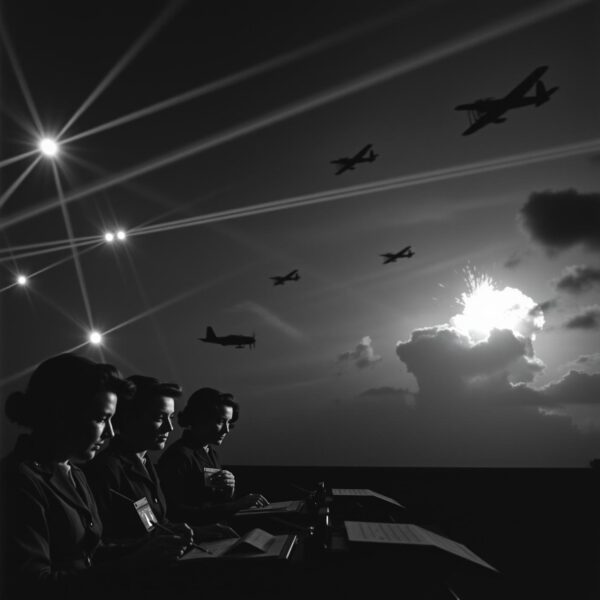
Antiaircraft fire
Antiaircraft fire prediction, developed during World War II, aimed to improve targeting of moving aircraft. Informed by the mathematician Norbert Wiener’s work on feedback systems and statistical prediction, it laid the groundwork for cybernetics and early artificial intelligence.
Amid’s Germany’s catastrophic arial attack on Britain, Wiener’s objective, as the historian Peter Galison notes, was to design an “intuitive” algorithmic calculating device which could model ‘an enemy pilot’s zigzagging flight, anticipate his future position, and launch an antiaircraft shell to down his plane’ (Galison, 1994: 229).
Wiener saw that, when it came to a ‘pilot, flying amidst the explosion of flak, the turbulence of air, and the sweep of searchlights, trying to guide an airplane to a target’ (Galison, 1994: 236), the statistical design of feedback mechanisms needed to address the interplay of machinic and human neurophysiological processes.
Although the “antiaircraft predictor” did not fully materialise during the war years, Wiener’s collaborative work with the computer engineer Julian Bigelow and the neurophysiologist Arturo Rosenblueth produced an understanding of human-machine relations in which ‘soldier, calculator, and fire-power [operated as] a single integrated system’ (Galison, 1994: 235).
This model of human-machine assemblage, alongside the ideas of feedback systems and black boxes, animated Wiener’s wider cybernetic vision. Its legacy also persists, however, in modern warfare technologies and algorithmic surveillance systems.