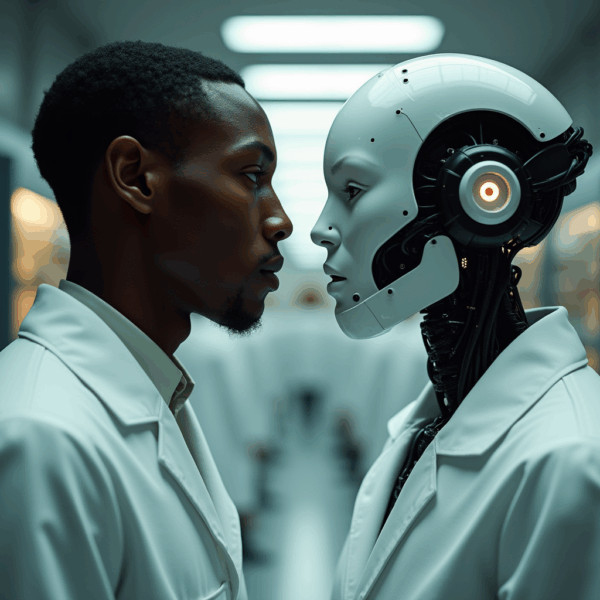
Electric brain
The term “electric brain” emerged in the 1940s and 1950s to describe early computers, reflecting hopes they could mimic human cognition. Linked to cybernetics and neural network research, it captured public imagination about digital computing’s potential.
Envisioning his electric calculating machines as “giant brains”, the mathematician Alan Turing, in a 1947 lecture for the London Mathematical Society, animated a future computer that ‘can learn from experience’, and which ‘must be allowed to have contact with human beings in order that it may adapt itself to their standards’.
This talk would inform Turing’s most famous article, ‘Computing Machinery and Intelligence’, published in 1950, which posed the provocative question, ‘Can Machines Think?’.
The cultural theorist Elizabeth A. Wilson (2010) situates Turing’s work within what the literary scholars Eve Sedgwick and Adam Frank call ‘the cybernetic fold’: a period ranging from the 1940s to the 1960s involving the interaction between ‘postmodern and modern ways of hypothesizing about the brain and mind’ (1995: 509). As a historical moment in which new digital computers were on the horizon but ‘the actual computational muscle’ required to animate such technologies was not yet available (1995: 508), conditions were ripe for unbounded anticipations of their future possibilities.
The metaphor of electric brains, however, was also subject to considerable criticism. For example, in his Lister Oration at the British Royal College of Surgeons on 9th June 1949, entitled ‘The Mind of Mechanical Man’, Turing’s senior colleague, the pioneering Manchester University neurosurgeon Geoffrey Jefferson, urged caution amid the fever pitch surrounding “electric brains”.
‘[N]either animals or men’, Jefferson argued, ‘can explained by studying nervous mechanisms in isolation, so complicated they are by endocrines, so coloured is thought by emotion’ (1949: 1107).
As public interest in the potential capacities of ‘electric brains’ heightened, Turing and Jefferson debated matters face-to-face in a historic 1952 BBC broadcast. Entitled ‘Can Automated Calculating Machines Be Said To Think?’, the programme also featured the Cambridge philosopher R. B. Brathwaite and the Manchester mathematician Max Newman, who had, alongside Turing, been a WWII code-breaker at Bletchley Park.
Although Turing’s fellow panellists had much to contest in his speculative vision of artificial intelligence, the significance of affect and the sensory to human behaviour assumed centre stage. Human interests, Brathwaite argues, are shaped by ‘appetites, desires, drives, instincts’, yet these machines ‘have rather restricted appetites and they can’t blush when they are embarrassed’.
Jefferson, in turn, stressed the difficulty (if not impossibility) of engineering human intuitive, tacit, and affective knowledge into digital computers, chiding Turing: ‘There would be too much logic in your huge machine’!