IAS Meteorology Project
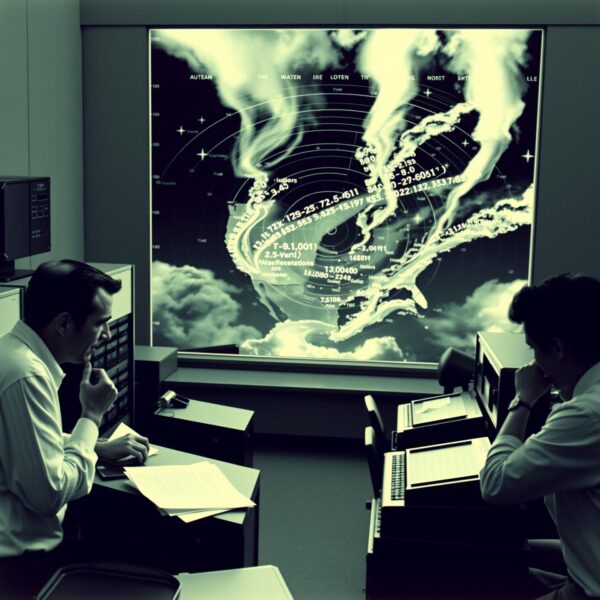
The IAS Meteorology Project (1946–1957), led by the mathematician John von Neumann and the meteorologist Jules Charney at the Institute for Advanced Study in Princeton, pioneered numerical weather prediction using early computers, including the ENIAC machine and the IAS computer.
Building on the mathematican Norbert Wiener’s cybernetics, it developed algorithms for weather forecasting and created the world’s first climate modelling software, with lasting impacts on climate science and predictive AI technologies.
A familiar narrative of twentieth century meteorology is that, with the advent of digital computing in the late 1940s, forecasting was transformed from an intuitive art into a computational science (Edwards, 2010). Yet an affective genealogy of weather prediction instead illuminates how these different modes of knowing and anticipating the world become newly interrelated within nascent algorithmic forecasting technologies.
As the IAS mathematician Herman Goldstein suggested in a 1947 letter to Pentagon officials, with its unprecedented computational power, the IAS computer would allow researchers to test their intuitive hunches about fluid dynamics, including the vexing problem of turbulence, through statistical means (IAS Electronic Computer Project archive).
Cybernetics, intuition, “electric brains”, and weather prediction become entangled in this post-war period, as digital computing enables new modes of perception and prediction in an atomic world riven with uncertainty.