Mathematical intuition
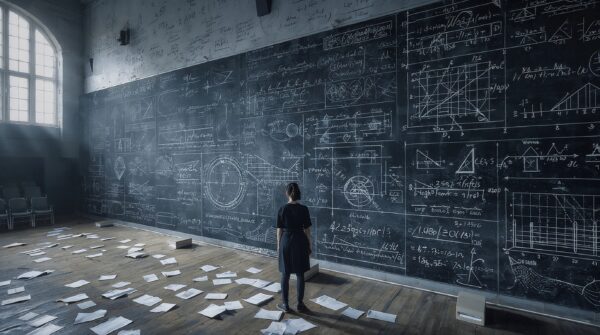
Mathematicians have long contemplated the role of intuition in computational logic and reasoning.
Such debates galvanised around a series of logic problems laid out by the mathematician David Hilbert in 1900 which, alongside the publication of Principia Mathematica (1910–1913) by the mathematician-philosophers Alfred North Whitehead and Bertrand Russell, explored the possibility of formalising all mathematical logic to eliminate theoretical uncertainties.
In response, the founder of the philosophy of “intuitionism”, mathematician L.E.J. Brouwer ([1927]1975), defended intuition as a cognitive activity vital to mathematical knowledge-building which runs counter to the automated theorem proving entailed by formalism.
In his 1939 paper ‘Systems of Logic Based on Ordinals’, the mathematician Alan Turing argued that mathematical reasoning depends on an iterative relationship between intuition and ingenuity. While ingenuity consists of ‘suitable arrangements of propositions’, intuition involves ‘making spontaneous judgments which are not the result of conscious trains of reasoning’ and is vital to mathematical discovery (Turing, 1939: 214-15).
From the 1960s, mathematicians began to approach intuition as fundamentally linked to context and experience and, in that sense, trained. Writing in Science, for instance, the mathematician R. L. Wilder describes mathematical intuition as ‘an accumulation of attitudes derived from one’s mathematical experience’ which is formed ‘by the cultural environment’ and is ‘of immediate importance to creative work’ (Wilder, 1967: 605-606).
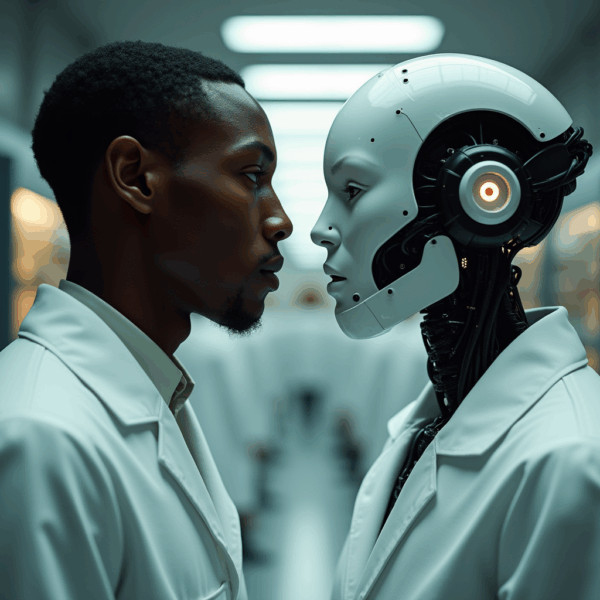
On one hand, these accounts of mathematical intuition seem to preserve it as an immanent human propensity resistant to formalisation, mechanisation, or codification. On the other hand, the very notion of intuition as trainable bolstered interest within computer science concerning how intuitive knowledge and decision-making could be engineered in machines (Pedwell, 2023).
The political geographer Louise Amoore argues that Turing’s account of intuition, in particular, can be interpreted as signalling how, even in the mid-twentieth century, ‘the human and machinic elements of mathematical learning … are not so readily disaggregated’ (Amoore, 2020: 57).
In this way, histories of mathematics reflect intuition’s more-than-human qualities in ways that anticipate how the ‘extended intuition of machine learning’ entangles human and algorithmic capacities to ‘feel its way towards solutions and actions’ (Amoore, 2020: 67).